Introduction
While 5-gallon bottled water may seem like simply filling large 18.9-liter containers with drinking water, the actual production process involves multiple steps, including empty container inspection, cleaning, disinfection, rinsing, metered filling, and capping. Since 5-gallon water containers are typically reused, their sanitation procedures and container handling methods differ significantly from those used for filling standard small bottles. Therefore, a complete 5-gallon filling machine is not merely a filling device but an automated system that integrates cleaning, filling, and capping.
So, how does a 5-gallon filling machine work? From the moment empty containers enter the machine, through cleaning, disinfection, and purified water filling, to automatic capping and finished product output, each step has corresponding equipment and control requirements. Below, we will detail the working principles, main equipment, filling process, and key factors affecting production efficiency and filling quality of a 5-gallon filling machine, following the actual production workflow.
What Is a 5 Gallon Filling Machine?
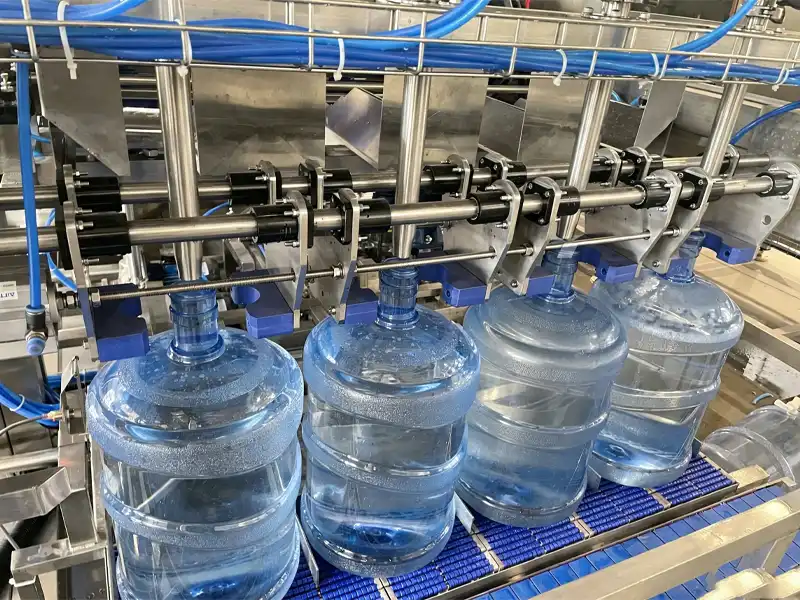
The 18L liquid filling machine is an automated device specifically designed to accurately and efficiently fill various liquid materials into standard 18-liter (approximately 5-gallon) containers. Its most common and typical application is the production of bottled water (purified water, mineral water), which is why it is often referred to as a “5-gallon bottled water filling machine.”
The 5-gallon filling machine integrates water collection, cleaning, disinfection, rinsing, precise filling, and capping into a single unit. It is suitable for applications such as bottled drinking water plants, purified water production, mineral water production, office water supply, and home drinking water delivery.
What Does a 5 Gallon Filling Machine Do?
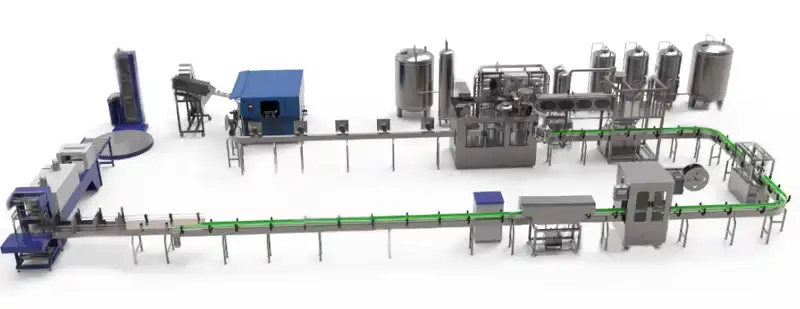
The 5-gallon filling machine handles the entire process from empty barrel handling to the output of finished water barrels, including empty barrel loading, internal and external washing, disinfection, purified water rinsing, drinking water filling, automatic capping, and finished product discharge. Depending on production scale and automation requirements, it can also be integrated with water treatment systems, conveying equipment, bagging machinery, and other units to form a complete 5-gallon bottled water production line.
5 Gallon Filling Machine vs Small Bottle Filling Machine
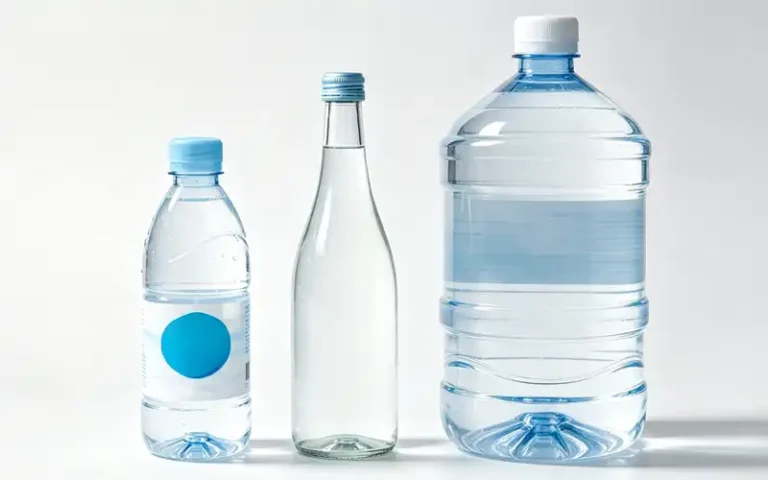
5-gallon filling machines are primarily designed for 18.9L reusable water containers, whereas small-bottle filling machines are typically used for disposable PET bottles in sizes such as 330mL, 500mL, 1L, 1.5L, or 2L. The two types differ significantly in terms of container type, conveying method, cleaning process, filling volume, and production workflow; notably, 5-gallon production lines usually incorporate specialized stages for container washing and disinfection.
| Feature | 5 Gallon Filling Machine | Small Bottle Filling Machine |
|---|---|---|
| Bottle size | 5 gallon / 18.9 L | 200 mL–2 L |
| Bottle type | Reusable containers | Mostly disposable PET/glass |
| Washing | Important | Usually rinsing |
| Filling volume | Large | Smaller |
| Bottle handling | Upright/heavy bottles | Lightweight bottles |
| Typical application | Water delivery stations | Retail bottled water |
How Does a 5 Gallon Filling Machine Work?
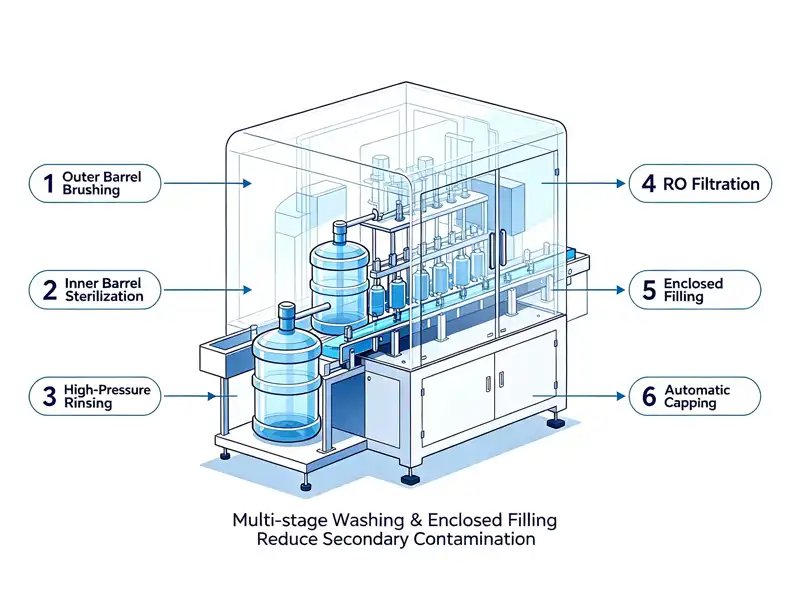
The operation of a 5-gallon filling machine involves more than simply filling a container with water; it encompasses a comprehensive process of cleaning, sanitizing, precisely filling, and sealing reusable water bottles. The complete cycle typically begins with the entry of empty bottles into the equipment, proceeding through inspection, pre-washing, cleaning and sanitization, final rinsing, filling, and capping, before the finished product is discharged. Specific process steps and the number of workstations vary depending on production capacity, water quality requirements, and the level of automation.
Step 1: Empty Bottle Loading and Inspection
Empty 5-gallon water bottles enter the production line via manual or automatic loading mechanisms. The equipment or operators inspect the bottles for defects such as cracks, deformation, severe scratches, or obvious contamination; bottles failing to meet standards are rejected, while compliant ones proceed to the subsequent cleaning stages.
Key Point: Since 5-gallon bottles are reusable, inspecting the bottle body prior to filling is a crucial step in ensuring hygiene during the subsequent cleaning and filling processes.
Step 2: Pre-Washing
Inspected bottles enter the pre-washing station, where water jets remove residual liquids, dust, and easily dislodged impurities, thereby preparing the bottles for deep cleaning.
Key Point: Pre-washing primarily targets obvious residues inside the bottle, reducing the workload for the subsequent cleaning stages.
Step 3: Bottle Washing and Sanitization
After pre-washing, the bottles move to the main cleaning station. Depending on the production process, cleaning agents, recirculated water, or other solutions are used to wash the interior and exterior, followed by required sanitization. Some systems feature multiple independent cleaning stations, allowing the bottles to undergo different stages of cleaning sequentially.
Key Point: This is a critical stage that distinguishes 5-gallon filling lines from standard small-bottle filling equipment, as 5-gallon bottles are designed for repeated use.
Step 4: Final Rinsing
Once cleaning and sanitization are complete, the bottles undergo a final rinse to remove traces of cleaning agents or other residues. Treated, clean water is typically used for this step, after which the bottles proceed to the filling area.
Key Point: The purpose of the final rinse is not only to remove residues but also to ensure a cleaner environment within the bottle for the subsequent filling of drinking water.
Step 5: Water Filling
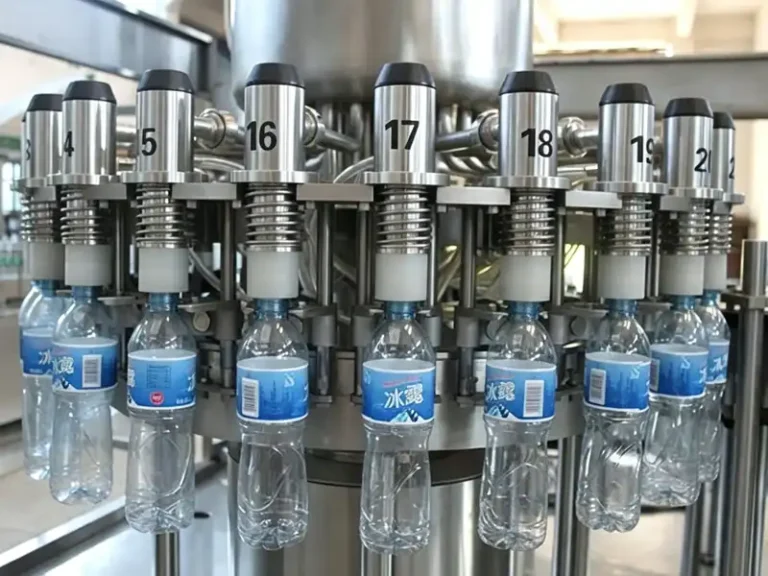
Cleaned and inspected water containers are conveyed to the filling station; the filling valve aligns with the container opening, and the filling process begins. The equipment regulates the water flow according to preset parameters, stops filling once the target volume is reached, and then proceeds to the capping stage.
Key Point: Filling stability depends on factors such as the filling valve, water supply pressure, flow control, and equipment configuration; the appropriate filling system should be selected based on target production capacity and water quality.
Step 6: Container Capping
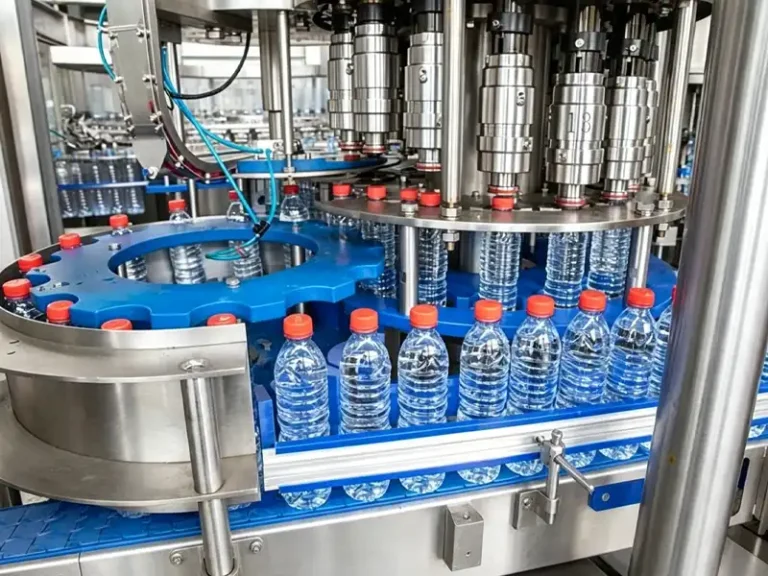
After filling, the equipment positions the cap over the container opening and performs a pressing or screwing operation to seal the container. Automated production lines integrate cap sorting, feeding, and sealing with the filling process.
Key Point: Capping affects not only the appearance of the finished product but also minimizes the risk of secondary contamination of the drinking water by the external environment after filling.
Step 7: Finished Container Discharge
Sealed 5-gallon containers exit the filling area via the conveyor system. They then undergo visual inspection, labeling, bagging, or other packaging processes as required by production specifications before moving to the finished product storage and distribution stages.
Key Point: Automated discharge reduces manual handling and creates a continuous production flow linking cleaning, filling, capping, and packaging.
Complete 5-Gallon Filling Process
Loading empty containers → Container inspection → Pre-wash → Wash → Disinfection → Final rinse → Metered filling → Automatic capping → Finished product output
Therefore, the core operating principle of the 5-Gallon Filling Machine can be summarized as “first processing the buckets, then performing hygienic filling, and finally completing sealing and output.” For a complete bottled water project, the filling system can also be connected to a water treatment system, storage tanks, conveying equipment, and packaging equipment to form a complete 5-gallon bottled water production line.
How Many 5 Gallon Bottles Can a Filling Machine Fill Per Hour?
The hourly output of a 5 gallon filling machine depends on several factors, including the level of automation, number of filling heads, bottle washing cycle, filling speed, and bottle conveying method. Therefore, the bottle size alone cannot determine the actual production capacity. Different machine configurations can be designed for different production requirements.
In general, semi-automatic 5 gallon filling equipment is suitable for smaller water plants, while fully automatic systems with multiple filling heads can handle higher production volumes. When selecting equipment, it is important to consider the complete process, including bottle washing, sanitization, filling, and capping, because the slowest process often determines the overall production capacity.
| Machine Type | Typical Capacity | Suitable Application |
|---|---|---|
| Semi-Automatic 5 Gallon Filling Machine | About 100–300 bottles/hour | Small water plants |
| Automatic 5 Gallon Filling Machine | About 300–600 bottles/hour | Medium-scale water production |
| High-Speed Automatic Line | 600+ bottles/hour | Large-scale continuous production |
Note: These ranges are for general equipment selection only. Actual output depends on the specific machine configuration and should be confirmed with the manufacturer’s test data.
How Accurate Is a 5 Gallon Filling Machine?
The standard filling accuracy for 5-gallon water filling machines typically ranges from ±0.1% to ±1%, though there are significant differences among machines from different manufacturers due to variations in technical specifications. The filling accuracy of a 5-gallon filling machine primarily depends on the filling valve, flow control method, water supply pressure, filling time, and equipment calibration. Consistent filling volumes help reduce underfilling, overfilling, and water loss during production.
Automatic filling equipment typically sets a target fill volume via the filling valve and control system, automatically stopping the water supply once the set parameters are reached. Actual accuracy depends on the specific filling method of the equipment and the manufacturer’s test data; therefore, when selecting equipment, it is important to focus on the actual filling error, repeatability, and filling performance at different production speeds.
Five causes of reduced accuracy: air bubbles in the material, unstable feed liquid level, sensor zero-point drift, significant environmental vibration, and incorrect parameter settings. These issues can generally be avoided by regularly calibrating the sensors with standard weights and maintaining a stable feed liquid level.
How Does a 5 Gallon Filling Machine Maintain Water Hygiene?
Since 5-gallon water containers are typically reused, container cleaning is a crucial step in ensuring the hygiene of the finished product. Filling machines generally process returned containers through multiple stages—such as pre-washing, washing, disinfection, final rinsing, and hygienic filling—to minimize internal residues and the risk of contamination.
During the filling process, piping, filling valves, and other critical components that come into contact with the water must be easy to clean and feature hygienic designs using materials suitable for drinking water production. Furthermore, the source water itself requires treatment via an appropriate water treatment system. In short, hygiene control for 5-gallon bottled water does not rely solely on the filling machine; rather, it is determined by a combination of factors, including water treatment, container cleaning, the filling environment, and the capping process.
How to Choose the Right 5 Gallon Filling Machine?
When selecting the right 5-gallon filling machine, you shouldn’t base your decision solely on the equipment price or hourly output; you also need to make a comprehensive assessment that takes into account bucket specifications, water source conditions, target production capacity, the level of automation, and available factory space.
- Production Capacity: Select the appropriate equipment specifications based on the target daily output and hourly output.
- Bottle Size & Type: Confirm the material, dimensions, and mouth specifications of the bottles to ensure compatibility with the equipment.
- Automation Level: Select a semi-automatic or fully automatic configuration based on production scale and labor costs.
- Washing & Sanitization: Focus on bucket processing procedures such as pre-wash, wash, sanitization, and final rinse.
- Filling Accuracy: Pay attention to filling valves, flow control, and filling stability to minimize water volume deviations.
- Complete Line Compatibility: Ensure the filling machine integrates seamlessly with water treatment, water storage, conveying, capping, and packaging equipment.
FAQs
Q1: What is a 5 gallon filling machine used for?
A1: A 5 gallon filling machine is designed for cleaning, sanitizing, filling, and capping reusable 18.9L water bottles. It is commonly used in bottled drinking water plants and water delivery businesses.
Q2: How does a 5 gallon filling machine work?
A2: The machine typically processes bottles through inspection, pre-washing, cleaning, sanitization, final rinsing, water filling, capping, and finished-bottle discharge.
Q3: How many bottles can a 5 gallon filling machine fill per hour?
A3: Capacity varies by machine configuration, automation level, filling heads, and washing cycle. Small systems may handle hundreds of bottles per hour, while high-speed lines can achieve higher output.
Q4: Can the machine wash and fill 5 gallon bottles?
A4: Yes. Many integrated systems combine bottle washing, rinsing, sanitization, filling, and capping, reducing manual handling between production stages.nd excessive foaming.
Q5: What type of water can be filled into 5 gallon bottles?
A5: The machine can be configured for different types of drinking water, including purified water, RO-treated water, and other bottled drinking water products, depending on the production process.
Q6: Is a 5 gallon filling machine fully automatic?
A6: It can be. Depending on production requirements, the system can include automatic bottle loading, washing, filling, capping, conveying, and discharge, or use a semi-automatic configuration.
Q7: How do I choose a 5 gallon filling machine?
A7: Consider production capacity, bottle specifications, automation level, washing and sanitization requirements, filling accuracy, factory space, and compatibility with the complete water treatment and packaging line.
Q8: What equipment is needed for a complete 5 gallon water filling line?
A8: A complete line may include a water treatment system, storage tanks, bottle washing machine, filling and capping machine, conveyors, labeling equipment, and packaging equipment.ng systems.
Conclusion
A 5 Gallon Filling Machine is more than a simple water filling device. It integrates bottle washing, sanitization, rinsing, filling, and capping to handle reusable 18.9L water bottles efficiently and hygienically. The right machine configuration depends on production capacity, bottle specifications, automation level, water treatment requirements, and factory layout.
For a complete 5 gallon water filling line, the filling machine should be properly matched with water treatment, storage, conveying, and packaging equipment. If you are planning a new bottled water project or upgrading an existing line, contact our team for a customized 5 gallon filling solution based on your production requirements.