Introduction
In the drinking water production industry, filling machines are the core equipment that determines production line efficiency. Many water plants and beverage manufacturers face the same dilemma when purchasing equipment: Why is there such a wide disparity in market prices for equipment designed for water filling? Do different water types—such as purified water, mineral water, and sparkling water—require dedicated filling equipment? And how should machine models be selected to accommodate different bottle sizes and production capacity requirements?
In fact, while drinking water may seem like a single product category, differences in water composition, packaging specifications, and production capacity result in vastly different suitable filling machine models. Drawing on years of hands-on industry experience and expertise in delivering international trade projects, this article—based on “Different Types of Water Filling Machines”—provides a comprehensive breakdown of the core features, suitable applications, and key selection criteria for various water filling machines. It aims to help manufacturers accurately select the right equipment, avoid common procurement pitfalls, control production costs, and improve production efficiency.
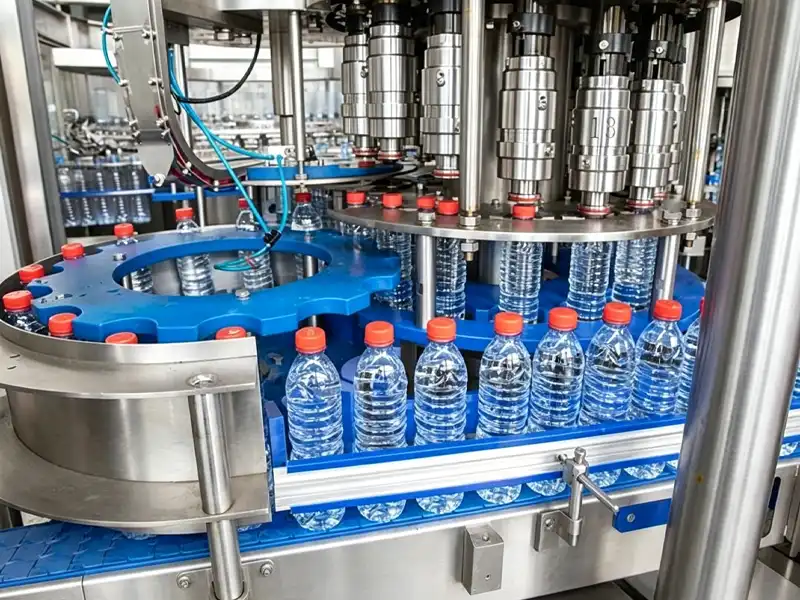
Classified by Filling Principle
1. Atmospheric Pressure Water Filling Machine
Atmospheric pressure filling machines are the standard equipment in the drinking water industry. They rely on the natural gravitational flow of water to complete the filling process. With a simple overall structure and straightforward operating logic, they are currently among the most stable and durable models available. Their extremely low failure rate makes them the mainstream choice for small and medium-sized water plants.
This equipment is specifically designed for purified water, deionized water, and ordinary still drinking water—that is, water that is clean, low in minerals, and not prone to foaming. With low procurement costs, convenient installation and commissioning, and simple daily maintenance, the equipment has no special requirements for production sites or operating environments and can meet the needs of stable, routine production. However, its shortcomings are also quite evident: it cannot handle water with high mineral content, water prone to foaming, or carbonated water, and is prone to issues such as uneven liquid levels and overflow. Overall, it is suitable for small- and medium-sized purified water plants, start-up water plants, and small-scale bottled water production lines.
2. Vacuum-Type Water Filling Machine
Mineral water and mountain spring water are rich in various minerals and have high water activity. Using standard atmospheric-pressure filling methods can easily result in a large number of bubbles, leading to inconsistent liquid levels, overflow at the bottle mouth, and insufficient fill volumes—all of which severely impact the appearance of the finished product and the product pass rate. The vacuum-type water filling machine is specialized equipment developed specifically to address this industry challenge.
The equipment uses the principle of vacuum suction to smoothly draw and fill water. The water flow remains steady throughout the process without violent agitation, eliminating issues such as foaming, overflow, and volume deviations at the source. This ensures that the liquid level in every bottle is uniform, resulting in a consistent, neat, and aesthetically pleasing appearance. Currently, all reputable mineral water and mountain spring water production facilities have adopted vacuum-pressure filling machines as core standard equipment, making them suitable for the large-scale production of various types of mineral drinking water.
3. Isobaric Water Filling Machine
For carbonated beverages such as sparkling water, soda, and carbonated drinking water, the greatest production challenge is preventing gas loss and filling splatter. Conventional filling methods can cause an imbalance in the internal bottle pressure, leading to product splatter and rapid gas pressure release. This directly results in poor product taste, carbonation levels that fail to meet standards, and a skyrocketing scrap rate.
Isobaric filling machines employ an operational mode that first balances pressure and then fills at a constant rate. By pre-balancing the pressure between the bottle and the storage tank, they ensure a fully sealed, pressure-stabilized filling process throughout. This effectively prevents gas leakage and product splashing, maximizes the preservation of the beverage’s original taste and carbonation levels, and significantly reduces production losses and the proportion of defective products. As such, they are essential equipment for carbonated drinking water production lines.
4. Flowmeter-Based Water Filling Machine
Compared to traditional filling equipment that determines volume based on liquid level height, the flowmeter-based water filling machine employs a precise flow measurement method that is independent of bottle height. It precisely controls filling volume through data-driven control, offering higher measurement accuracy and greater adaptability.
The equipment’s greatest advantage is its ability to accommodate the production of multiple product specifications. When companies frequently switch between water bottles of different capacities—such as 330 ml, 500 ml, 1 L, and 2 L—there is no need to repeatedly adjust equipment parameters; production modes can be switched with a single button, significantly reducing changeover and debugging time while enhancing production flexibility. It is ideally suited for high-end purified water manufacturers with diverse product lines, varied packaging specifications, and stringent requirements for filling accuracy.
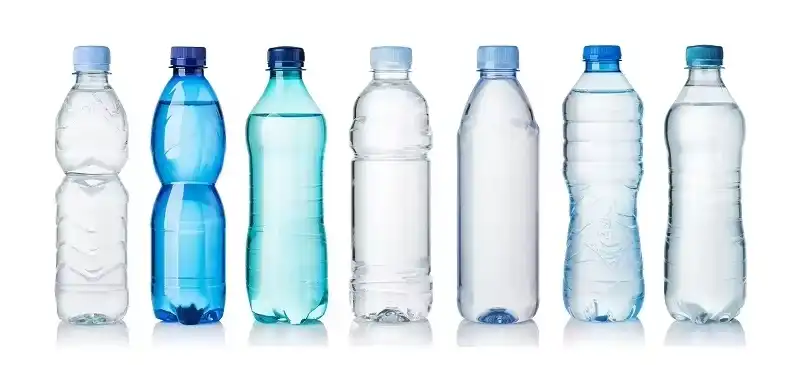
Classified by Packaging Specifications
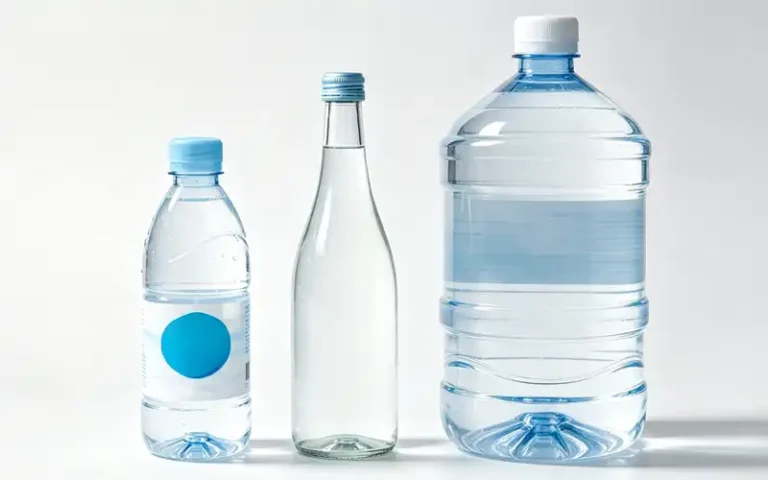
In addition to filling principles, bottle shapes and capacities serve as the primary criteria for companies when selecting equipment. Different specifications of drinking water packaging correspond to dedicated filling production lines, enabling precise matching to various production capacities and scenarios.
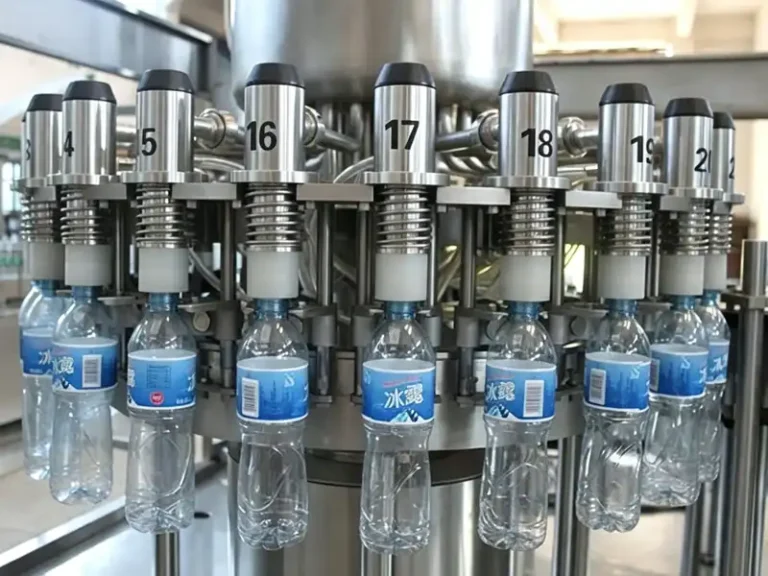
- Small-Bottle Water Filling Machine (330 ml–1 L): Featuring a high-speed rotary “three-in-one” integrated design, this machine automates the entire process—from bottle washing to filling and capping. With a high degree of automation and fast mass production speeds, it is perfectly suited for the large-scale, standardized production of mainstream small-bottle drinking water on the market.
- Large-Bottle Water Filling Machine (1.5L–10L): Equipped with servo control and flow metering systems, this machine has been optimized to address common issues with large-capacity packaging—such as spillage and inaccurate dosing—ensuring stable output and precise metering. It is suitable for the production of household and commercial large-bottle drinking water.
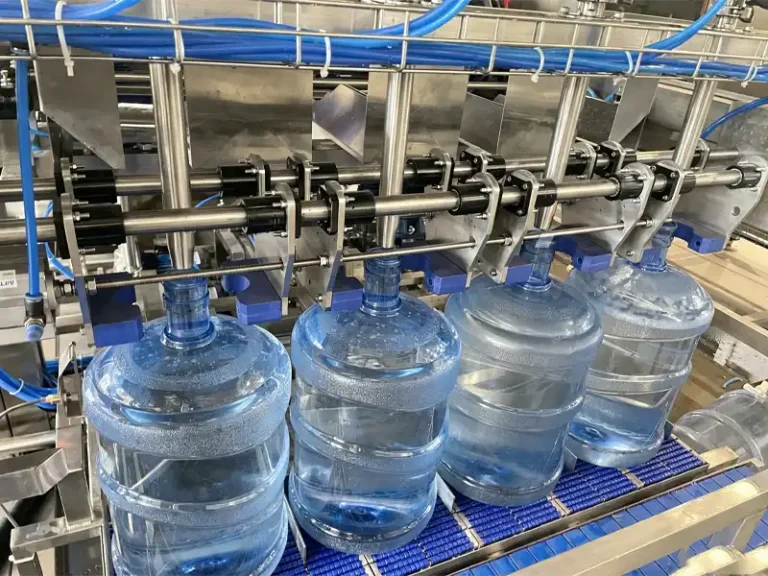
- Bucket Water Filling Machine (18.9L/20L): A fully automated production line dedicated to bucket water, covering the entire process from outer bucket washing and high-pressure inner bucket rinsing to aseptic filling and automatic capping. The fully automated operation complies with the high-standard hygiene production specifications for bottled drinking water.
- Custom Filling Machines for Non-Standard Bottles: We offer customized filling equipment for all types of non-standard and custom-designed water bottles. We can tailor production lines to meet specific bottle shapes and production requirements, accommodating diverse and customized production scenarios.
By Level of Automation
Selecting equipment with the appropriate level of automation—based on production scale, daily capacity requirements, and budget—is key to controlling production costs and avoiding resource waste.
- Semi-automatic water filling machines: Compact in size with a small footprint and low procurement cost, these machines offer easy installation and commissioning, flexible product changeovers, and a very low failure rate. Designed specifically for startups and small processing plants with limited budgets and needs for low-volume, multi-variety production, they support flexible, small-batch operations and effectively reduce the burden of initial equipment investment.
- Fully automatic integrated filling machines (3-in-1 or 4-in-1): These integrate multiple functional modules—such as bottle rinsing, filling, capping, and conveying—into a single unit. They operate fully automatically without manual intervention, supporting stable, continuous 24-hour mass production. Characterized by high standardization, consistent product quality, and excellent hygiene standards, they significantly reduce labor costs and are ideal for medium-to-large drinking water enterprises requiring stable, large-scale production.
- Complete turnkey production lines: These encompass the full range of equipment, including water treatment systems, bottle blowing, filling, labeling, coding, packaging, and warehousing/conveying systems. They provide a comprehensive, one-stop solution for new water plants, large-scale production projects, and export-oriented ventures, eliminating the need for customers to source additional equipment and enabling immediate production upon installation.
By Industry Classification
| Water Type / Production Scenario | Recommended Filling Machine |
|---|---|
| Purified Water / Pure Water | Prefer Gravity Filling Machines or Flow Meter Filling Machines |
| Mineral Water / Spring Water / Mineralized Water | Vacuum (Negative Pressure) Filling Machines are recommended |
| Sparkling Water / Soda Water / Carbonated Drinking Water | Isobaric (Counter-Pressure) Filling Machines are required |
| Multiple Bottle Sizes / Frequent Product Changes | Flow Meter Filling Machines are a flexible choice |
| Small-Batch Production / Limited Budget | Semi-Automatic Filling Machines |
| Large-Scale Standardized Production | Fully Automatic 3-in-1 Monoblock Filling Machines |
Water Filling Machine Purchasing Guide
Based on extensive experience in project delivery and after-sales service both domestically and internationally, we have found that most companies’ production failures, insufficient production capacity, and poor cost-effectiveness stem from misjudgments made during the equipment selection phase. The following common issues can be effectively avoided:
Never mix incompatible equipment models. Using atmospheric-pressure equipment for bottled mineral water or mountain spring water will inevitably lead to problems such as widespread foaming, uneven liquid levels, and a skyrocketing defect rate; Using standard filling equipment for carbonated drinking water will directly result in gas loss and product splashing, rendering the product unfit for market release.
Avoid blindly following trends when purchasing equipment. Small-scale water plants with small orders and multiple product categories do not need to purchase high-speed, fully automated production lines, as this can easily lead to equipment idling, wasted capital, and a prolonged payback period; At the same time, do not blindly pursue low prices. Poor-quality equipment made of thin materials is prone to rust and has poor sealing performance. Not only does this compromise filling stability, but it can also contaminate the water, making the product unable to pass food safety inspections.
Pay close attention to the configuration of core equipment components. Pumps, piping, and seals are key to ensuring long-term, stable operation. Inferior components are prone to dripping, leaking, and seepage, leading to frequent downtime for repairs and increased operational and maintenance costs.
FAQs
Q1: What are the main types of water filling machines?
A1: The main types include gravity, flow meter, vacuum, and isobaric filling machines. The right option depends on water characteristics, bottle type, filling accuracy, production capacity, and whether the product is carbonated.
Q2: Which water filling machine is best for purified water?
A2: Gravity and flow meter filling machines are commonly used for purified water. The choice depends mainly on required filling accuracy, bottle sizes, production speed, and the level of automation required.nes.
Q3: Which filling machine is suitable for mineral water?
A3: Vacuum or negative-pressure filling machines are commonly considered for mineral and spring water. The final selection should be based on water properties, bottle design, production capacity, and filling requirements.
Q4: What filling machine is used for sparkling water?
A4: Sparkling water requires an isobaric or counter-pressure filling machine. The system maintains pressure between the product tank and bottle during filling to reduce carbonation loss and excessive foaming.
Q5: What is a 3-in-1 water filling machine?
A5: A 3-in-1 water filling machine combines bottle rinsing, water filling, and bottle capping in one integrated machine. It is commonly used in automated bottled water production lines.
Q6:Should I choose a semi-automatic or fully automatic water filling machine?
A6: Semi-automatic machines are suitable for small production volumes and limited budgets. Fully automatic machines are better for continuous production, higher output, reduced manual labor, and standardized bottling operations.
Q7: How do I choose the right water filling machine?
A7: Consider the water type, bottle material, bottle volume, required capacity, filling method, automation level, available space, and future production plans before selecting a machine.nts.
Q8: What is the difference between a water filling machine and a water filling line?
A8: A water filling machine normally focuses on the filling operation, while a complete water filling line can include water treatment, bottle blowing, rinsing, filling, capping, labeling, coding, packaging, and conveying systems.
Conclusion
Although water filling machines may appear simple in structure and easy to operate, they have stringent requirements regarding water quality compatibility, bottle type compatibility, production capacity, and hygiene standards. When purchasing equipment, there is no absolute distinction between “high-end” and “low-end”; rather, the key is to select a model that aligns with your specific production environment, capacity requirements, and budget. Careful model selection not only ensures the efficient, stable, and compliant operation of the production line but also reduces material waste, labor costs, and operational and maintenance costs over the long term, thereby enhancing the competitiveness of your products in the market.
Snowy Owl Water: With years of experience in R&D, customization, and global delivery of drinking water filling equipment, we offer free, one-on-one production line design consultations, precise quotations, and customized services based on our clients’ water quality, packaging specifications, hourly production capacity, production facilities, and industry compliance standards. We provide global clients with highly adaptable, cost-effective, and comprehensive drinking water filling solutions.